
The rest of the internet is still figuring it out.
Nearly half of U.S. consumers say they've used TikTok to search for something — up from 41% just two years ago, according to a 2026 Adobe Express survey. Among Gen Z, that number climbs to 65%. Those are usage figures, not a verdict on whether TikTok has replaced Google — it hasn't, and Google is still where most people, Gen Z included, start a search. What the numbers actually show is scale: enough people are asking TikTok real questions that the platform had to decide what a "result" looks like when the answer isn't a link.
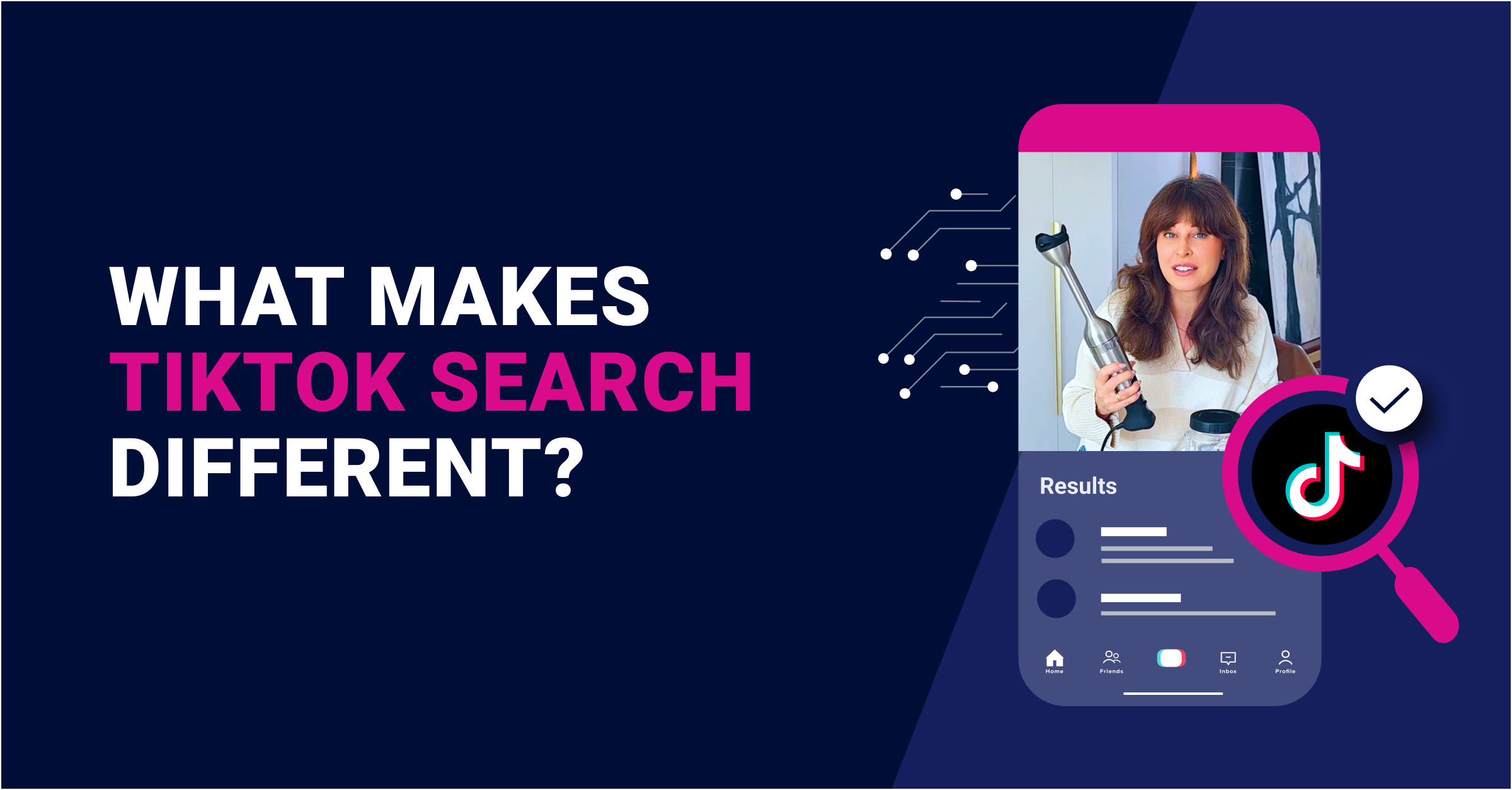
TikTok's answer is a video, not a link to one, and not a summary with a "watch more" button stapled on. The creator's content sits right inside the app where you typed the question. For a long stretch, TikTok didn't even need an AI layer between the question and the video. It just needed the video.
TikTok now runs its own AI synthesis layer on top of search: Tako, an in-app chatbot, plus AI-generated overviews that summarize a video before you watch it. It's the same move Google and ChatGPT are making — generate an answer, then hand the viewer off to a source — but built on a library TikTok owns outright, ahead of most of the industry agreeing on what to call the category.
What Makes TikTok Search Architecturally Different
On most search engines, a good result sends you elsewhere. On TikTok, the result is already there, and now a synthesis step sits in front of it, built entirely from TikTok's own content and TikTok's own AI.
TikTok Search is a working preview of generative search that never leaves the platform. Its AI layer reads and summarizes creator content directly, rather than sending a query out to the open web and stitching an answer together from a dozen domains. Google's AI Mode and ChatGPT do a version of this that spans the internet, pulling from YouTube, Reddit, Instagram, news sites, wherever the most credible content lives in that moment. TikTok skips that search entirely. It built its summary layer on top of a library it already owns, using signals like captions, on-screen text, comments, and watch-through behavior that only exist because creators were already answering questions natively, in their own words, long before anyone called this "AI search."
The Closed Loop, Redefined
The original loop was simple: a creator makes content, the platform surfaces it as a search answer, the viewer gets what they came for, the creator gets a signal, and the brand briefs more content based on what worked. That loop still closes entirely inside TikTok. Nobody bounces to a competitor's platform to get their answer, and that part hasn't changed.
What changed is the middle step. A synthesis layer now sits between the question and the video: Tako, or an AI Overview surfaced under a caption, synthesized across several pieces of creator content before the viewer sees any of it. Only then does the viewer decide whether to click into the underlying video, or the next one Tako suggests. Saying "the platform surfaces it as a search answer" undersells what's actually happening. The platform is generating that answer, and the creator's video is now one step removed from the first thing a searcher sees.
Publishers have made the same complaint about Google AI Overviews for two years: synthesis captures the value, and the click-through to the original source turns optional. Because TikTok owns both the synthesis and the content it's synthesizing, that value has nowhere else to go. The loop still closes at home. It just closes one step later than it used to.
Where the Rest of the Internet Is Heading
TikTok isn't alone in building a synthesis layer, and it isn't the only one struggling to get it right.
Google has spent 2026 pushing AI Mode everywhere it can, including onto YouTube. In April, YouTube began testing “Ask YouTube,” an AI Mode-style feature (powered by Gemini) that answers multi-part questions with a mix of generated text and video clips, then lets users ask follow-ups the way they would in a chat window. It's the same shape as Tako: an AI layer sitting in front of a massive owned video library, deciding what to surface and in what order. YouTube is already the most frequently cited social source in AI-generated answers across ChatGPT, Perplexity, and Google's own AI products — Ask YouTube is Google building a front door directly onto that advantage, on its own turf, instead of leaving the summarizing to someone else.
ChatGPT and Perplexity are doing the open-web version of the same thing: pulling from Reddit threads, Instagram posts that Google started indexing in 2025, TikTok captions, review sites, wherever the most specific, credible content on a topic happens to live that week. Perplexity in particular has built its entire pitch around this: instead of ranking pages the way Google traditionally has, it retrieves whatever it judges the most credible, specific source to be, synthesizes across a handful of them, and shows its work with citations attached. The mechanic converging across all of these — creator and community content becoming the answer, not just a path to one — is the same one TikTok built first. The difference is provenance. TikTok's synthesis layer draws from a single, closed content library it fully controls. Google and OpenAI's synthesis layers draw from an open web they can crawl but don't own, which is a harder, messier problem with a lot more room for things to go wrong.
TikTok has already found some of that room. Its AI Overview feature started testing in late April 2026 and got scaled back within two weeks after generating summaries so wrong they went viral for the wrong reasons — a video of creator Charli D'Amelio was described as "a collection of various blueberries with different toppings," and a ballroom dance clip was summarized as someone hitting their head with a rubber chicken. TikTok pulled the feature back to a narrower use case — mostly identifying products shown in a video — while it works out what went wrong. It's a useful reminder that TikTok's architectural head start doesn't mean its execution is finished. The summary layer is still maturing, the same way every other LLM-powered search product is still maturing. Being first doesn't mean being done.
What Brands With Strong TikTok Creator Programs Already Have
A deep, well-briefed creator library on TikTok is more valuable now. Specific, first-person, answer-oriented content has always been the best raw material for AI summarization, whether the summarizer is TikTok's own Tako or an outside LLM pulling from the open web.
Brands that understood this well before "AI Overview" was a phrase anyone used had already found the format's real point: creators answering real questions at scale, with search, discovery, and conversion collapsing into a single piece of content because that's what a genuinely useful answer looks like.
Brands that briefed for that outcome all along are the ones whose libraries are already legible to a synthesis layer, TikTok's or anyone else's. Brands that briefed for reach and vibes are going to find out the hard way which kind of content actually survives the transition to generative search.
The practical version of this shows up in the brief itself, long before anyone's measuring citations. A creator video with a vague caption and a trending sound gives a synthesis layer almost nothing to work with. TikTok's own AI Overview experiment struggled with exactly this kind of thin, visual-only content, which is part of why it mistook a dance video for a plate of fruit. A creator video built around a specific, answer-shaped claim (what it fixed, how long it took, what to expect) gives Tako, an AI Overview, or an outside LLM something concrete to summarize accurately. The brief doesn't need to mention AI at all. It just needs to ask for the same specificity that's always made creator content trustworthy in the first place.
|
Traditional search |
Open-web AI search |
TikTok Search |
|
|---|---|---|---|
|
What the result is |
A link |
A generated summary, sourced across many outside domains |
The creator's content itself |
|
Where synthesis happens |
Nowhere — you click through |
Between the searcher and the open web |
Inside a single platform, over its own library |
|
Where the loop closes |
On someone else's site |
Wherever the citation sends you |
Inside the same app |
The unlock was never the algorithm. It was always the creator.
TikTok didn't get to a working version of generative search by inventing a smarter model than everyone else's — it's currently proving, in public, that the model part is genuinely hard. What TikTok had first was a library of people answering real questions in specific, credible, native detail, at a scale no synthesis layer could ignore. Every other platform converging on this architecture is chasing that same input. The brands that already understood creators were building the answer, not just the path to it, aren't starting this next phase from zero.