+144
QoQ Revenue Growth Q4 2025
$4.11
ROI during 2025 BFCM
9+ yrs
of partnership
The Challenge
Enterprise Retail at Platform Scale
Most brands entering a new channel start over. The institutional knowledge from the last platform — how the algorithm learns, which audience signals matter, what creative actually converts — rarely carries over. Usually because the partner who built it didn't stay long enough to bring it somewhere new.
What happens when it does carry over is a different story.
In 2017, QVC came to what is now Trevant with one of retail's more demanding paid media problems. Facebook and Instagram were maturing into serious retail channels, and QVC needed a partner with the infrastructure to run them at true enterprise scale. What followed was nine years of expansion — channel by channel — where the decisions made on one platform became the foundation for the next one.
Background
QVC came to AdParlor — now Trevant — with a specific and demanding problem. Facebook and Instagram were maturing into serious retail channels, and QVC needed a partner with the infrastructure to run them at true enterprise scale.
QVC doesn't run a few campaigns. They run hundreds simultaneously. The core of the paid social operation was built around three distinct campaign types, each requiring its own architecture, creative cadence, and measurement approach:
-
A complex promotional calendar: 24-to 48-hour promotional campaigns built around specific products and time-sensitive promotions. Each required rapid turnaround, precise scheduling, and performance monitoring against a tight window.
-
Dynamic campaigns: Product-level retargeting and prospecting that adapted to individual users in real time, drawing from QVC's deep and diverse product catalog across beauty, home, apparel, and electronics.
-
Always-on brand programs: Full-funnel campaigns designed to build brand consideration and purchase intent over months, not days.
The additional complexity: all of this had to run across two brands — QVC and HSN — with different product calendars, different audience compositions, and different performance mandates. A mistake in scheduling or budget allocation on one brand could not come at the expense of the other.
That complexity was the test. And it was what we were built for.
The Approach
Infrastructure Before Optimization
From day one, the priority was building the operational infrastructure capable of handling the volume before reaching for performance gains. That meant establishing clean campaign architecture, rigorous naming conventions, and QA processes that could scale without breaking down. It also meant investing early in the relationship between the agency team and QVC's internal stakeholders; understanding the product calendar, the seasonal rhythms, and the business objectives behind each campaign type.
That foundation, built carefully and deliberately, is what made every subsequent expansion possible.
Building the System
Expanding the Program Channel by Channel
Over the years that followed, the partnership expanded organically alongside the business. No single expansion was driven by a traditional agency sales pitch. Each one was driven by a new business need that QVC identified, and that the existing relationship gave Trevant the context to respond to quickly.
Meta Expansion: Dynamic, Brand & Advantage+
The initial Meta program grew in sophistication and scope. Standard prospecting and retargeting campaigns evolved into a full-funnel architecture that included Meta Dynamic (catalog-fed product ads personalized at the individual level), dedicated brand campaigns designed to build upper-funnel equity, and eventually Advantage+ campaigns as Meta's AI-driven optimization tools matured. Each layer added reach, precision, or efficiency to the existing structure, without replacing what was already working.
As Pinterest developed into a meaningful retail discovery channel, QVC extended its paid media investment there. The product catalog and the platform's visual format were a natural fit, and the existing infrastructure for managing a large SKU set translated directly.
TikTok Paid
TikTok's growth as a retail-adjacent platform made it the next logical expansion. QVC entered TikTok paid with a clear hypothesis about the platform's audience and a measurement framework designed to evaluate it honestly. The learnings from those early TikTok campaigns, about what content formats drove engagement, what audiences converted, and how the algorithm behaved at different budget levels, would prove invaluable when TikTok Shop entered the picture years later.
YouTube
QVC recognized YouTube's potential as a video-first storefront and partnered with Trevant to unlock its full value. We refocused the platform strategy around demand generation, aligning organic content and paid amplification across every stage of the funnel to drive stronger end conversions, increase revenue and ROAS, and deepen audience engagement. We amplified key products, promotional moments, and creator-led content to maximize performance at scale.
Organic Programs
The partnership eventually extended into organic content management alongside paid, creating a more cohesive presence across platforms and giving Trevant deeper visibility into how organic and paid worked together to move audiences through the funnel.
The Attribution Dashboard: One View Across the Mix
As the media mix grew more complex, the measurement challenge grew with it. Platform-reported data and first-party data from QVC's own analytics tools told different parts of the story, but not always the same one.
We built a custom attribution dashboard that brought Adobe's first-party data into the same reporting environment as platform data, giving QVC a single, reconciled view of return across an increasingly complex multi-channel program. This wasn't a standard off-the-shelf integration. It was built specifically to reflect how QVC measured its business, a meaningful investment in the partnership's long-term infrastructure.
By the time the creator economy started maturing, QVC had a paid media operation that was among the most sophisticated in retail. That foundation mattered more than anyone anticipated.
The Creator Thesis
The Challenge: Reaching New Audiences in New Formats
By 2024, QVC's paid media operation was mature and performing. The challenge was a different one: how to reach younger audiences who were spending more time in creator-native environments and less time in the formats traditional paid media could reach.
YouTube was the platform where this gap was most significant. QVC's YouTube presence had grown as a paid media channel, but the content running against it was largely owned brand assets; content built for QVC's traditional formats and repurposed for the platform rather than built natively for it. The hypothesis: YouTube-native creator content, built for how the platform's audiences actually consume media, would meaningfully outperform owned assets in a paid media environment.
Building the YouTube Creator Program
August 2024: Taking Over HSN YouTube Paid
Trevant assumed management of HSN's YouTube paid media program in August 2024, giving the team full visibility into both how the platform was performing as a paid channel and where the content gap was most pronounced. This provided the baseline data needed to build a credible case for the creator program that followed.
April 2025: QVC YouTube Paid Launches
With both HSN and QVC under management, the team had a rare opportunity to test hypotheses across two comparable retail brands simultaneously — a meaningful advantage in evaluating what was driving performance.
May 2025: Creator Program Launch
The YouTube creator program launched in May 2025, starting deliberately small. Two creators per brand — two for QVC, two for HSN — with clear performance briefs and a measurement structure designed to answer the core question honestly rather than optimistically: does YouTube-native creator content outperform owned assets in a paid media environment?
The brief to creators was specific. The goal wasn't awareness content or aspirational brand-building in the traditional influencer sense. It was content that converted on YouTube, built natively for the platform's formats, authentic to the creator's voice, and designed to function as paid media creative as well as organic content. That distinction, creator content as a performance asset, not just a brand asset, was foundational to how the program was structured.
Q4 2025: Scaling on Proof
The initial data confirmed the hypothesis. Creator content built natively for YouTube outperformed owned assets across the efficiency metrics that mattered most for the paid program. Armed with that proof, QVC and Trevant secured incremental investment in Q4 and scaled the program significantly ahead of the holiday season.
From 4 creators across both brands at launch, the program scaled to 20 total creators by Q4:13 on the incremental fund and 7 on standard investment. The creator mix included both posting creators (producing long-form and short-form YouTube content) and UGC-focused creators providing assets for paid amplification. Today, the program runs at approximately 11 active creators per month: 7 posting creators (4 QVC, 3 HSN) and 4 UGC creators (2 QVC, 2 HSN).
What the YouTube Chapter Proved
The results went beyond validating the effectiveness of creator content itself. What YouTube proved was that when creator content was paired with the same performance discipline that had powered QVC's paid program for seven years — rigorous briefing, structured measurement, optimization cadences built around platform learning rather than instinct - the output was fundamentally different from the typical influencer program.
This wasn't influencer marketing in the conventional sense. It was a scalable content and media engine: a system that produced authentic platform-native assets and then deployed them with the measurement rigor of a paid media operation. The creator roster became a repeatable asset, not a series of one-off bets. Specific creators, identified through performance data rather than follower counts, became recurring partners.
That system, and the discipline underlying it, became the model for what came next.
TikTok Shop: Rewrote the Rules of Scale
The Challenge: Scale Without Efficiency Decay
When QVC built its TikTok Shop operation, the question wasn't whether the platform had commercial potential. It clearly did. The question was whether they could grow it aggressively without the performance decay that typically accompanies rapid budget growth.
Most brands treat that tradeoff as inevitable: spend goes up, efficiency goes down. QVC and Trevant treated it as a problem to be engineered around. The approach they developed was structural, not tactical; four decisions made early that compounded through the year.
The Approach: Four Structural Decisions
1. GMV Max as a Learning System, Not a Campaign Type
GMV Max's algorithm builds efficiency from every dollar of consistent investment. Each purchase signal refines the system's understanding of who converts, when, and at what price: compounding intelligence that makes future spend more efficient than the spend that preceded it.
The key was committing to that consistency early, not hedging with conservative budgets that starve the algorithm before it can reach a stable learning state. Every dollar invested in the early stages of the program was an investment in the system's future efficiency.
2. Catalog Depth and Affiliate Scale as Fuel
GMV Max performs best with rich, diverse inputs. QVC's product catalog, spanning beauty, home, apparel, electronics, and more, gave the algorithm the breadth to find the right product for the right buyer at the right moment, rather than over-indexing on a narrow SKU set.
A robust affiliate creator network kept content fresh, authentic, and diverse across formats without depending on in-house production alone. Together, catalog depth and affiliate volume shortened GMV Max's learning curve and accelerated the path to stable, efficient delivery.
3. Category-Based Campaign Architecture
Rather than running one broad GMV Max campaign across all products, Trevant broke QVC's investment into category-specific campaigns: Household Appliances, Beauty, Apparel, Electronics, Luggage, and more. This gave the algorithm cleaner optimization signals and made it possible to identify high-performing segments in real time - and push harder into them while holding back on categories where the algorithm was less efficient.
Category campaigns consistently outperformed all-products campaigns, particularly for a catalog as large and varied as QVC's, where a single broad campaign dilutes optimization signals across too many SKUs for the algorithm to specialize effectively.
4. Sustained, Calculated Investment
QVC increased TikTok Shop spend by more than 80% year-over-year, tripling daily media investment while maintaining return targets. The sustained investment philosophy was grounded in a simple principle: a well-structured system rewards consistency over time. Starving the algorithm during high-demand periods is a false economy; it sacrifices the learnings that make future spend more efficient.
The results reflected that compounding philosophy: ROI not only held steady as spend increased, it improved.
The Results
What Nine Years Actually Built
The Results: Q4 2025
Q4 2025 was QVC's strongest quarter on TikTok Shop by every measure. 897K orders, up 90% from the prior quarter.
The Efficiency Story
The efficiency narrative is where the real proof lives. Spend grew 104% quarter-over-quarter. Returns scaled faster than investment.
December tells the clearest part of the story. After BFCM had passed and budgets had normalized — on 21% lower spend than the November peak - the ROI floor in December was higher than it had been in early October. November's heavy investment had trained the algorithm. December benefited from those learnings, delivering better efficiency at a lower budget level. The system had learned.
BFCM: Structure Under Pressure
Black Friday and Cyber Monday put the category architecture to its clearest test. QVC's category GMV Max campaigns — led by Household Appliances, Phones/Electronics, and Luggage/Bags — drove a 4x ROI at peak competition, when most brands were watching efficiency erode. The structure allowed Trevant to push budgets aggressively where the algorithm showed strength and hold back on lower-performing segments; scale and precision, at once.
Beyond Revenue: A Customer File That Grew
The most lasting result from TikTok Shop in 2025 wasn't a revenue number. Over one million net-new U.S. customers entered the QVC ecosystem through TikTok Shop in 2025: people who had never purchased from QVC before. At scale, the program didn't just convert existing demand. For the first time in over four years, it grew QVC's total customer file.
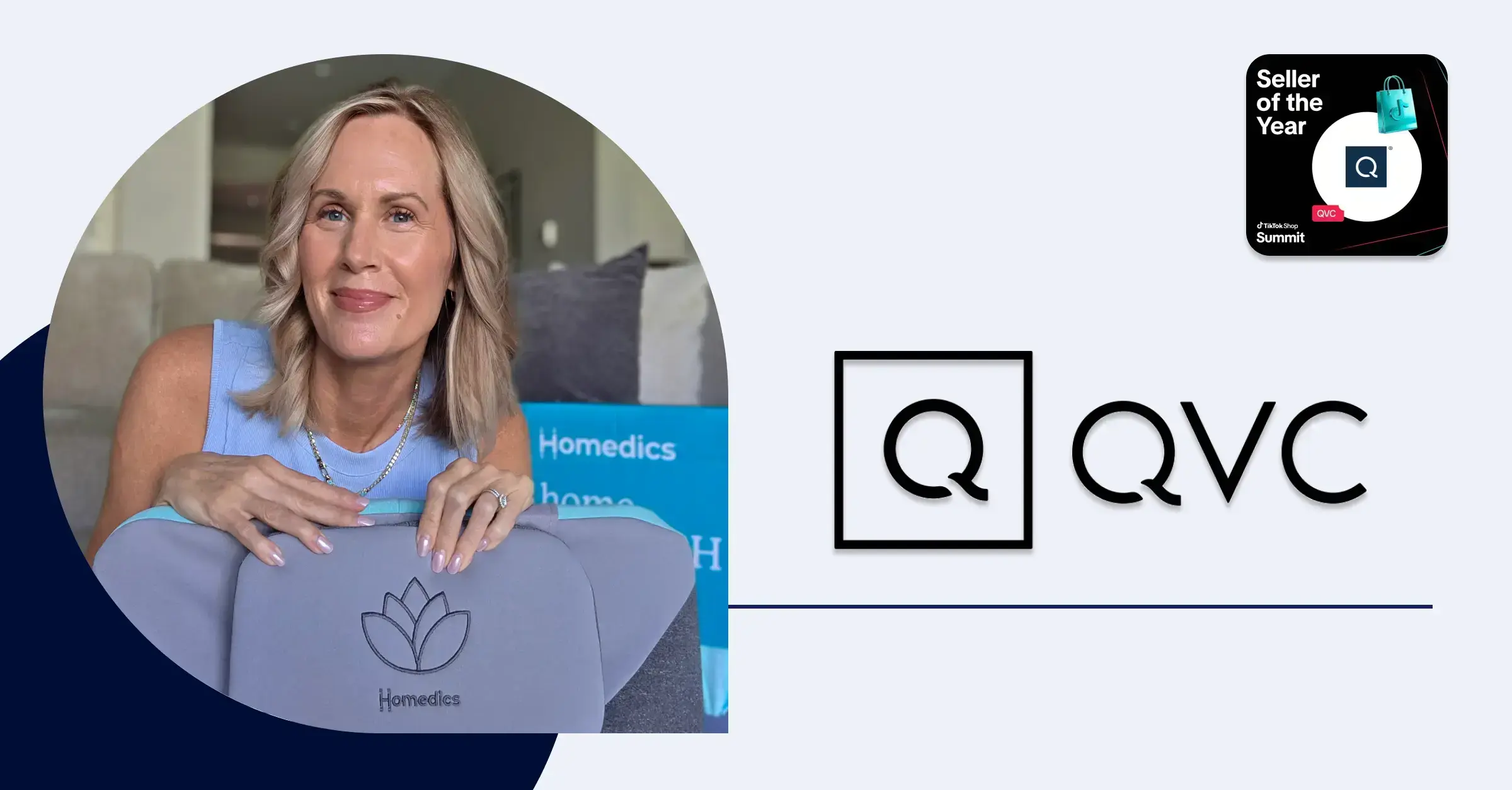
TikTok named QVC its Shop Seller of the Year.
It would be easy to tell the TikTok Shop story in isolation. The numbers are strong enough to stand on their own. It would be easy to tell the YouTube creator story as a standalone win. The hypothesis worked. The program scaled. Specific creators became repeatable bets.
But there’s a larger story here about the scale of impact driven by the length and depth of our partnership.
The performance discipline that powered GMV Max at scale — the category structure, the sustained investment philosophy, the measurement rigor that kept optimization signals clean across a large SKU set — came from years of running one of retail's most complex paid media programs. The creator expertise that made YouTube content the highest-efficiency lever in QVC's media mix came from understanding the audience, the products, and the platform dynamics before the creator brief ever arrived.
Nine years compounded those decisions. But the decisions came first.
For QVC, it started in 2017 with how the first campaigns were structured — clean architecture, rigorous measurement, a team that learned the business before it optimized the spend. The compounding followed from the right foundation set on day one.
Impact Summary
2017–present
The foundation
Partnership began in 2017 on Facebook and Instagram. Expanded channel by channel as each new platform became a real retail channel worth building on:
- Custom attribution dashboard built to unify first-party data and platform data into a single reporting environment
2025
YouTube creator program
- Creator content outperformed owned brand assets across efficiency metrics in paid media
- Highest content efficiency in program history at Q4 peak
2025
TikTok Shop
- December ROI higher than early October on 21% lower spend — November's investment trained the algorithm; December collected on it
- Customer file grew for the first time in over four years